



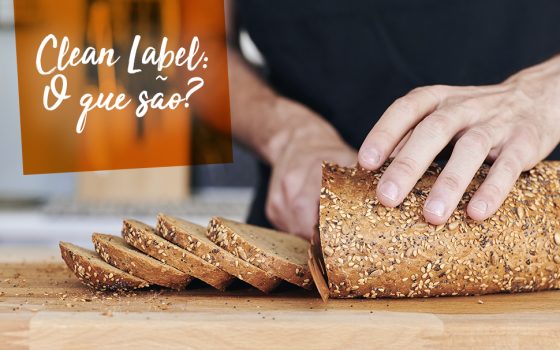
The concept of Clean label in baking. It has gained relevance in recent years as consumers have begun to pay closer attention to ingredient lists on food products. Instead of evaluating only price and taste, many consumers now also value clarity in labeling and formulations with recognizable ingredients.
For the baking industry, this movement signifies not only a change in communication, but also a technical reflection on formulations, production processes, and preservation strategies.
But after all, What truly characterizes a clean label product, and how can this concept be applied safely and effectively in an industrial setting?
What is clean label and why isn't there a single definition?
The expression clean labelThe term "clean label," or "clean label," does not have a formal regulatory definition. In other words, there is currently no specific legislation that establishes mandatory criteria for a food to be classified as clean label.
In general, the concept is related to clearer formulations for the consumer, with simpler ingredient lists and transparent communication about the product's composition.
In practice, clean labeling is more closely linked to consumer perception and market positioning strategies than to a technical or legal classification.
Therefore, different companies and food categories may adopt distinct approaches to meet this market expectation.
Why has the clean label movement gained global traction?
The advancement of clean label is directly related to changes in consumer behavior.
Today, access to information allows people to research ingredients, buy products, and evaluate labels more carefully before making purchasing decisions.
Furthermore, there is a growing appreciation for foods that convey naturalness, transparency, and simplicity in their formulation.
In various food categories, especially in baking, this drives the development of products that combine... sensory quality, food safety and clarity of composition.
For the industry, the challenge lies in meeting this expectation without compromising expectations. standardization, lifespan and production efficiency.
The technical challenge of clean labeling in baking.
Bread production involves significant technical challenges, especially when it comes to microbiological control and shelf life.
Breads and baked goods are naturally susceptible to the development of molds and other spoilage microorganisms, making the adoption of technological strategies for preservation and stability essential.
In this context, the industry can resort to different approaches, such as:
- strict process control
- proper selection of functional ingredients
- fermentation technologies
- conservation strategies and shelf life
- combination of technological solutions in formulation
In other words, developing products that meet market expectations requires technical analysis and formulation planning, always considering industrial performance and food safety.
Sourdough starter: a technical solution aligned with clean label standards.
Among the strategies used in modern baking, the natural fermentation It has gained prominence for contributing to both the sensory profile and the technological behavior of the masses.
A sourdough, obtained from the fermentation of flour and water by lactic acid bacteria and specific yeasts, generates natural compounds that influence various characteristics of the final product.
During the fermentation process, organic acids such as lactic acid and acetic acid are produced, which contribute to:
- reduction of the pH of the dough
- development of characteristic aroma and flavor
- improving the texture of bread
- building a more stable microbiological environment
In addition to sensory aspects, natural fermentation can also contribute to structure, crispness, and aromatic complexity, characteristics often associated with artisanal products.
For this reason, sourdough starter has been increasingly used in both industrial baking and artisanal bakeries, especially when the goal is to combine tradition and process control.
Clean labeling requires strategy, not just ingredient substitution.
One of the most common misconceptions when talking about clean label is believing that simply removing certain ingredients from the formulation is enough.
In reality, developing products aligned with this concept involves a complete technical analysis of the production process.
It is necessary to evaluate:
- microbiological stability
- impact on shelf life
- process standardization
- control of fermentation variables
- industrial cost
Without this technical perspective, the pursuit of a simpler label can lead to increased losses, inconsistent quality, and regulatory risk.
Therefore, clean labeling should be treated as a technological and product development strategy, and not just as a one-off change to the ingredient list.
The role of technical innovation in baking.
The evolution of industrial baking increasingly depends on the integration of food science, ingredient technology, and process control.
Companies that invest in innovation are able to develop formulations that balance:
- industrial performance
- microbiological stability
- sensory quality
- market positioning
In this scenario, choosing the most suitable technologies and ingredients for each application is essential to ensure productivity, safety, and consistency of the final product.
PMAN's expertise in developing solutions for the baking industry.
A PMAN works in the development of Technical solutions for the baking industry., offering a diverse portfolio that helps companies optimize formulations and production processes.
Speak with a PMAN specialist. e Discover how to integrate solutions into your clean label strategy while maintaining performance and industry standardization.

